Onboard Equipment for Heavy Machinery: Which Sensors You Actually Need
- Автор
- Ivan Ivanovych
- Дата
- 4 July 2026
- Час читання
- 6 min read
"Install monitoring for us" — half of our customer conversations start with that. Then it turns out monitoring means very different things, and the real question is which sensors you need and what for.
Extra sensors are wasted money. Missing ones are blind spots in the very reports the whole thing was bought for.
The core: terminal and GNSS
The heart of the kit is the onboard terminal. It collects sensor data, buffers it while the link is down and transmits to the server over radio, LTE or Wi-Fi. For a quarry the terminal needs a rugged housing, a wide supply-voltage range and operation from −40 to +60 °C. Power spikes on heavy machinery are routine, not an emergency.
The GNSS receiver provides position, speed and heading. In a deep pit the satellite signal weakens near the walls, so we select the antenna and its placement specifically and adapt coordinate processing to work inside the "bowl".
Sensors worth starting with
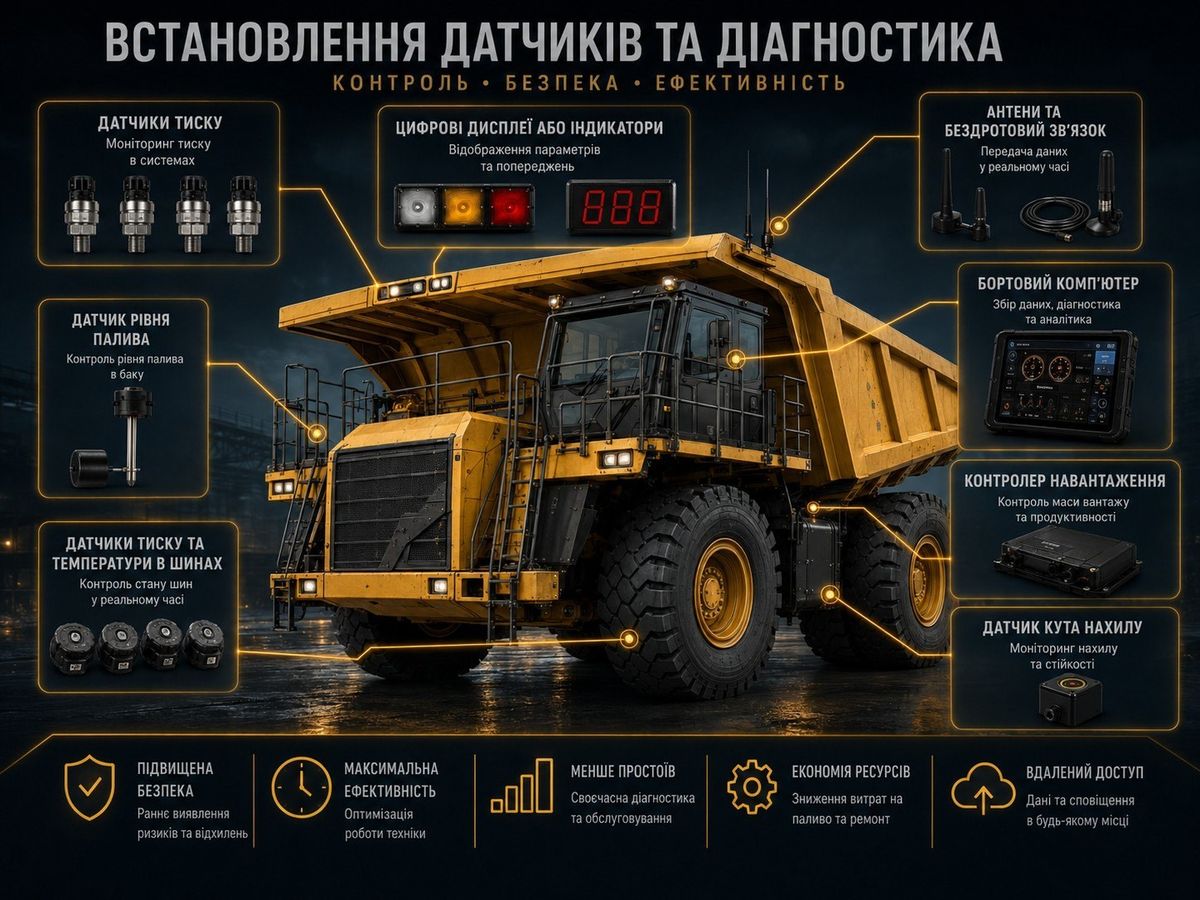
- Fuel level, a capacitive in-tank sensor. Refuelling and drain control. Pays back fastest of anything on this list.
- Payload: suspension pressure or strain gauges. Tonnage without a weighbridge, plus control of the overloading that kills frames and tires.
- Engine hours and modes, from the CAN bus or discrete inputs. Real runtime for maintenance instead of logbook entries.
- Tire pressure and temperature. The machine's most expensive consumable deserves its own sensor.
- Driver identification, RFID or iButton. When it is known who is driving, driving style gets noticeably neater.
Why we build the hardware ourselves
A mass-market automotive tracker does not live long on a haul truck. Heavy-equipment vibration and the electrical quirks of mining machinery finish it off within months. We went through that with customers twenty years ago, which is why we design and manufacture our own onboard equipment — from the PCB to the housing and mounts.
A side benefit: repairs and upgrades do not depend on an outside vendor. The hardware is serviced in Kryvyi Rih, and firmware gets adjusted to a specific plant's needs rather than "maybe in the next release".
Not sure where to start? Describe your fleet and what hurts most — fuel, downtime or tires. We will configure a kit for that, not a "fully loaded just in case" one.