What a Quarry Dispatching System Is and How It Pays Off
- Автор
- Ivan Ivanovych
- Дата
- 4 July 2026
- Час читання
- 6 min read
A mining haul truck costs millions. An hour of it standing still is hundreds of dollars of ore nobody hauled.
Now an honest question: who on your site knows how many such hours there were yesterday? On most operations where we started work, the answer was the same: nobody. There is a radio, a paper dispatcher log and numbers taken on someone's word. Dispatching exists to replace "on someone's word" with data.
How it works
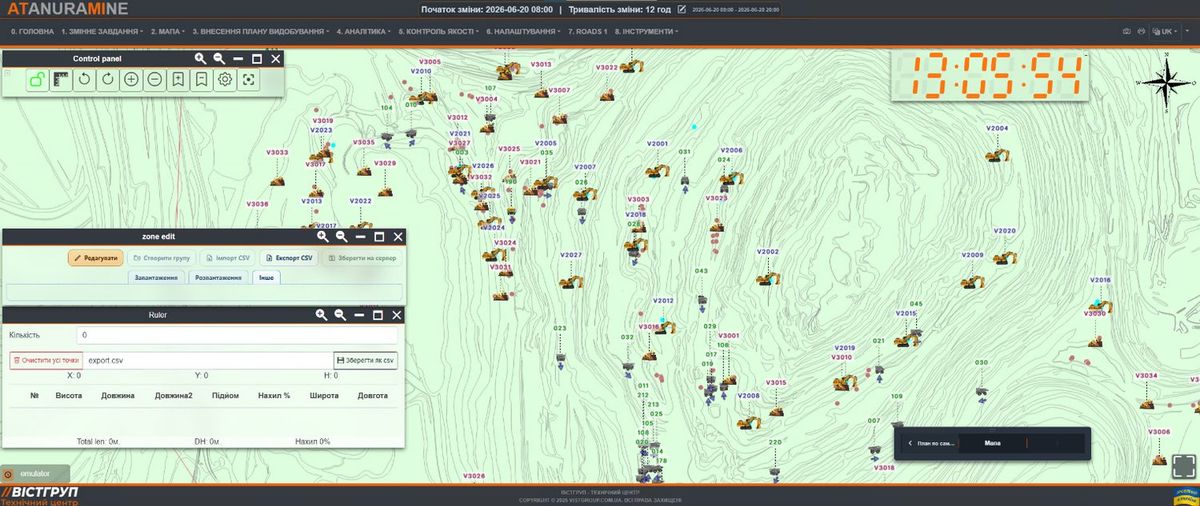
Every machine gets an onboard kit: a GNSS receiver, an onboard computer and sensors for fuel, payload and engine hours. Data travels over a radio link or LTE to the plant's server. On the quarry map in the control room the dispatcher sees each machine: where it is, whether it runs empty or loaded, whether it queues at the excavator or sits at the fuel station.
Every load-haul-dump cycle is registered automatically. The shift report builds itself. That matters more than it sounds: a number nobody typed in by hand is a number nobody argues with.
What changes day to day
The first thing customers see after launch is downtime nobody suspected. Fifteen minutes waiting at the excavator here, ten on a crossing there. Per machine it looks like noise. Across a fleet over a month it adds up to hundreds of machine-hours.
Then the system starts suggesting: which excavator an empty truck should head to so it does not join a queue. The dispatcher stops firefighting and starts managing the flow.
- Every stop is logged with a reason and duration.
- Trips and tonnage count themselves — the argument about what a shift "really" did is over.
- Refuellings and fuel burn are visible per machine.
- Management sees productivity by machine, crew and route for any period.
How much money it returns
On the projects we support, haulage productivity grows by roughly 10–20% — with zero new machinery. Queues get shorter and hidden downtime stops being hidden, that is the whole trick. Fuel control usually adds another 10–15% saved on diesel.
For a fleet of 10–20 trucks that means payback within the first year. After that it is extra trips on the same iron.
What ATANURA is
ATANURA is our own platform, designed for the conditions of Ukrainian quarries and mining plants rather than adapted from light-vehicle tracking. We build the onboard hardware ourselves, deploy the server side on the customer's site, train the dispatchers and do not disappear after launch. We have worked with mining enterprises of the Kryvyi Rih basin for over 20 years, including Metinvest group plants.
If you are thinking about digitalizing a quarry, start with dispatching. Fuel control, tire monitoring and robotization will all build on its data later.